跳至內容

購物車

您的購物車為空

DIAMOND EDUCATION

Diamond Buying Guide

Choosing a diamond is not about finding the highest grade in every category. It is about understanding which characteristics influence beauty, size, quality and price — then deciding what matters most to you.

01 — CHOOSE YOUR DIAMOND TYPE

Natural or lab-grown?

Both can make a beautiful centre stone. The difference begins with origin, rarity and how you choose to allocate your budget.

LAB-GROWN

Lab-Grown Diamonds

Lab-grown diamonds are created in controlled environments using technology that reproduces the conditions in which diamond crystal forms.

For many buyers, their main advantage is the ability to consider a larger stone or higher specifications within the same budget.

NATURAL

Natural Diamonds

Natural diamonds formed beneath the earth over geological timescales and are valued by many clients for their natural origin and comparative rarity.

The right choice is personal. We recommend deciding first what origin means to you, then comparing diamonds within a budget that feels comfortable.

02 — START WITH SHAPE

Choose the silhouette you love.

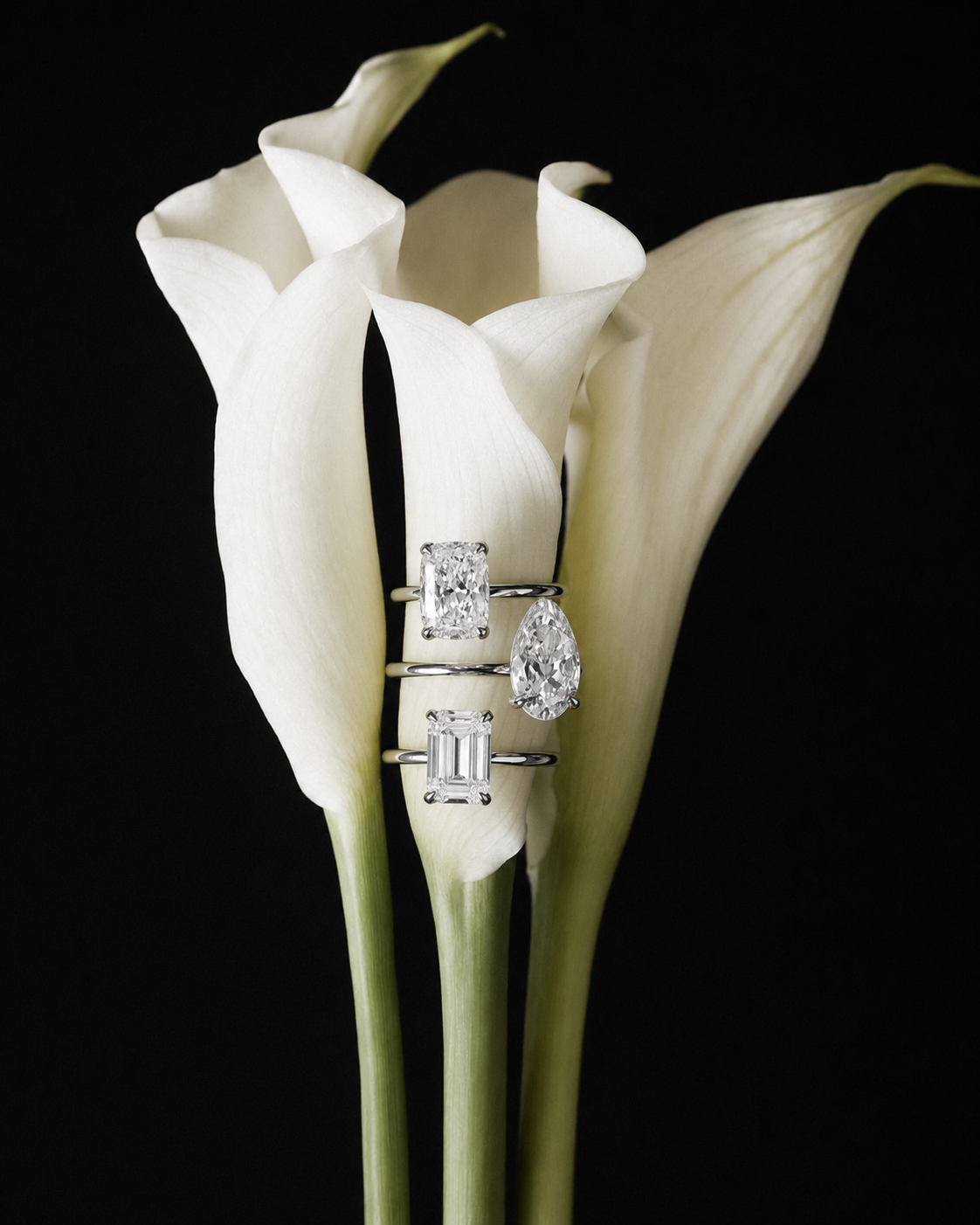
Shape is usually one of the easiest decisions to make because it has an immediate effect on the personality and proportions of the finished ring.

01

Round

Classic, balanced and known for brilliant light performance.

02

Oval

Elongated, elegant and generous in face-up appearance.

03

Emerald

Architectural step facets with a clean, sophisticated look.

04

Radiant

Angular outline with lively brilliant-style faceting.

05

Cushion

Soft corners with a romantic square or elongated silhouette.

06

Pear

A distinctive combination of rounded and pointed proportions.

07

Marquise

Long and dramatic with excellent visual spread.

08

Princess

A contemporary square shape with brilliant faceting.

09

Asscher

Geometric step facets with a distinctive hall-of-mirrors effect.

10

Heart

Expressive, recognisable and unmistakably romantic.

03 — UNDERSTAND THE 4Cs

Four grades. Different priorities.

Cut, colour, clarity and carat provide a useful framework for comparing diamonds, but they should be considered together rather than treated as four independent scores to maximise.

01

Cut

Cut describes how effectively a diamond has been proportioned and faceted to interact with light. For round brilliant diamonds, cut quality can have a major influence on brightness, fire and overall visual performance.

Our approach: prioritise attractive cut and proportions before automatically increasing carat weight.
02

Colour

For white diamonds, colour grades describe how little body colour is observed under controlled grading conditions. Differences between neighbouring grades can be subtle once a diamond is mounted.

Shape, size and metal colour can all influence how colour is perceived in the finished ring.

Our approach: choose a grade that looks appropriately white for the stone and setting rather than paying automatically for the highest possible grade.
03

Clarity

Clarity grades describe internal and external characteristics seen under standard grading conditions.

A higher clarity grade does not necessarily create a visibly more beautiful diamond. Inclusion type, size and position can matter as much as the grade itself.

Our approach: focus on a visually clean stone rather than paying for microscopic rarity you may never see.
04

Carat

Carat is a measurement of weight, not diameter or visible size. Two diamonds with the same carat weight can look noticeably different from above because of their shape and proportions.

Our approach: compare millimetre measurements as well as carat weight when judging size.

BUY THE DIAMOND, NOT JUST THE GRADE

Two diamonds can share similar grades and still look different.

A grading report gives you valuable information, but it cannot communicate every aspect of a diamond's appearance. Proportions, inclusion placement, transparency, facet pattern and the individual character of the stone can all influence what you actually see.

04 — LOOK BEYOND THE 4Cs

The details that change how a diamond looks.

01

Measurements

Look at length and width in millimetres as well as carat weight. These dimensions tell you much more about how large the diamond will appear from above.

02

Length-to-Width Ratio

Ratio is especially useful for oval, radiant, cushion, emerald, pear and marquise diamonds. A lower or higher ratio can make the same shape appear noticeably wider or more elongated.

03

Depth & Table

These proportions describe how weight is distributed through the diamond and can influence face-up spread and light behaviour. They are useful reference points, but should not be judged independently of the rest of the stone.

04

Inclusion Placement

A clarity grade alone does not tell you where an inclusion sits. A small inclusion near the edge may be far less noticeable than one positioned directly under the table.

05

Fluorescence

Fluorescence describes how some diamonds react under ultraviolet light. Its effect varies from stone to stone and should be considered in context rather than automatically treated as positive or negative.

06

Facet Pattern

Fancy shapes can show very different patterns even when their grading information looks similar. This is especially important with ovals, cushions, radiants, pears and step cuts.

05 — CHECK THE GRADING REPORT

Certification gives you a common language.

An independent grading report documents important information about a diamond, including characteristics such as measurements, carat weight, colour and clarity.

WHAT TO CHECK

Read beyond the headline grades.

Review the report number, measurements, proportions, clarity characteristics and other available grading information.

For certain diamonds, additional information such as inscription details can help you verify the stone against its report.

REMEMBER

A report supports the decision — it does not make it for you.

Certification is extremely useful when comparing diamonds, but two stones with similar reports can still have different visual characteristics.

Use the grading report together with the available images, video, proportions and overall appearance.

06 — THINK ABOUT THE RING

Your diamond does not exist in isolation.

The setting changes how a diamond is framed, protected and perceived on the hand. Choosing the diamond and ring together often leads to a more considered result.

SOLITAIRE

Let the centre stone lead.

A simple solitaire puts almost all visual attention on the centre diamond, making shape, proportions and face-up appearance especially important.

HALO & SIDE STONES

Consider the complete composition.

Additional diamonds create more overall brilliance and can change how large or prominent the centre stone appears.

METAL

Metal influences the final look.

White metals create a cooler visual frame, while yellow or rose gold introduce warmer contrast. Metal colour can also influence how you perceive the diamond once it is set.

07 — SPEND WHERE YOU CAN SEE IT

Build your budget around your priorities.

There is no universal rule for how much an engagement ring should cost. Start with a comfortable budget, then decide which characteristics deserve the greatest share of it.

01

Choose your shape.

Start with the silhouette you genuinely prefer rather than choosing only according to price per carat.

02

Decide how much visual size matters.

Use both carat weight and actual measurements to determine the presence you want on the hand.

03

Protect beauty and proportions.

Avoid sacrificing too much cut quality or attractive proportions simply to reach a particular carat number.

04

Choose an appropriate colour range.

Consider the shape and metal before paying for a colour difference that may be difficult to notice in the finished ring.

05

Aim for visually clean clarity.

Once inclusions are difficult to see without magnification, higher clarity grades may deliver diminishing visual benefit.

08 — BEFORE YOU CHOOSE

Your diamond checklist.

Before making your final selection, make sure you have looked beyond the carat number and headline grades.

Shape Do you genuinely love the silhouette?
Measurements Check actual length and width, not only carat.
Proportions Review ratio, depth and table where relevant.
Colour Is the grade appropriate for the shape and metal?
Clarity Consider inclusion position as well as the grade.
Certification Review the grading report and report number.
Setting Will the stone work beautifully with your ring design?
Budget Are you paying for differences that matter to you?

CONTINUE LEARNING

A little knowledge makes choosing easier.

01

The 4Cs Explained

Go deeper into cut, colour, clarity and carat and understand what each grade can — and cannot — tell you.

Read the 4Cs Guide
02

Responsible Sourcing

Learn more about how we approach diamond sourcing, production partners and quality control.

Learn More
03

Personal Guidance

Comparing several diamonds? Send us the options you are considering and we can help you look at the differences.

Contact Us

COMMON QUESTIONS

Before you choose your diamond.

Which of the 4Cs is most important?
There is no single answer for every diamond shape. For round brilliant diamonds, cut quality deserves particular attention because of its influence on light performance. For fancy shapes, proportions, facet pattern and overall appearance are also especially important. We recommend balancing all four Cs rather than maximising one grade in isolation.
Is a higher clarity grade always better?
A higher clarity grade represents fewer or less significant clarity characteristics under grading conditions, but it does not necessarily create a visible improvement to the naked eye. For many buyers, a visually clean diamond provides a sensible balance between appearance and price.
Is carat the same as diamond size?
No. Carat measures weight. Visible size is influenced by the diamond's shape and proportions. Always compare the actual length and width measurements when deciding how large a diamond will appear on the hand.
What is a good length-to-width ratio?
There is no universally correct ratio for most fancy shapes. Ratio largely determines whether a diamond appears wider, more balanced or more elongated. The best ratio is therefore the one that produces the silhouette you prefer.
Should I choose the diamond or setting first?
Either approach works. Start with the diamond if the centre stone's shape, size or specifications matter most to you. Start with the setting if you already know the style of ring you want. Our Ring Builder supports both journeys.
Can you help me compare diamonds?
Yes. If you have shortlisted several diamonds and would like help understanding the specifications, proportions or other available information, contact us and share the stones you are considering.

READY TO EXPLORE?

Find the diamond that feels right for you.

Compare shape, size, specifications and price — then pair your chosen diamond with a setting to create your ring.